You turn the knob on your stove and nothing happens — the coil stays cold, the glass surface does not glow, or the gas burner clicks without lighting. A burner that will not heat is one of the most common stove problems, and in most cases the cause is straightforward to diagnose.
This guide covers both electric and gas stove burners, explains why each type fails, and walks you through the fixes you can safely handle yourself.
Quick Answer: If your electric stove burner is not working, the most common causes are a burnt coil element, a damaged element socket, or a failed infinite switch. For gas stoves, the leading cause is a clogged burner port or a faulty spark igniter. Start by swapping the burner to a different position — if the problem follows the burner, the element is bad. If it stays in the same position, the switch or wiring is the issue.
Electric Stove Burner Problems
1. Burnt or Broken Coil Element
On traditional electric coil stoves, the coil elements are the most common failure point. Coils develop cracks, breaks, or burn spots over years of use. When a coil breaks internally, it stops conducting electricity and stops heating.
Visually inspect the coil for obvious damage — cracks, blisters, or flat spots. A coil that looks intact may still have an internal break, which you can detect with a multimeter set to continuity. No continuity means the coil needs to be replaced.
2. Damaged Element Socket
The element socket — the receptacle that the coil plugs into — can develop a poor connection over time, especially if the coil has been removed and reinserted repeatedly. Signs of a damaged socket include burn marks, pitted contacts, or a loose fit when you plug in the coil.
If a burner works in one socket but not another, the socket is the problem. Replacing an element socket is a common repair that involves removing the cooktop, disconnecting the old socket, and wiring in a replacement.
3. Failed Infinite Switch
The infinite switch is the control knob assembly that regulates power to the burner. When this switch fails, the burner may not heat at all, may heat only on high, or may not turn off when the knob is in the off position.
Testing an infinite switch requires a multimeter and access to the switch terminals behind the knob. If the switch does not send voltage to the element when turned on, it needs to be replaced.
4. Cracked Radiant Element (Glass-Top Stoves)
Smooth-top electric stoves use radiant heating elements under a glass-ceramic surface. These elements can develop breaks in the heating wire, which appear as a dark spot or a section of the element that does not glow. Because the glass surface is not serviceable, the entire radiant element assembly must be replaced.
A cracked glass cooktop is a different issue — if you see a visible crack in the glass surface, do not use the stove until the cooktop is replaced, as the crack can spread and create an electrical hazard.
5. Wiring Issue
The wiring between the infinite switch and the element can come loose, develop a poor connection at a terminal, or short against the stove chassis. Wiring problems are more common in older stoves and stoves that have been moved or serviced.
Visually inspect the wiring behind the knob panel and under the cooktop. Look for burnt wire connectors, melted insulation, or wires that have come loose from their terminals. If you find a damaged wire, replace it with wire of the same gauge and type.
Gas Stove Burner Problems
1. Clogged Burner Ports
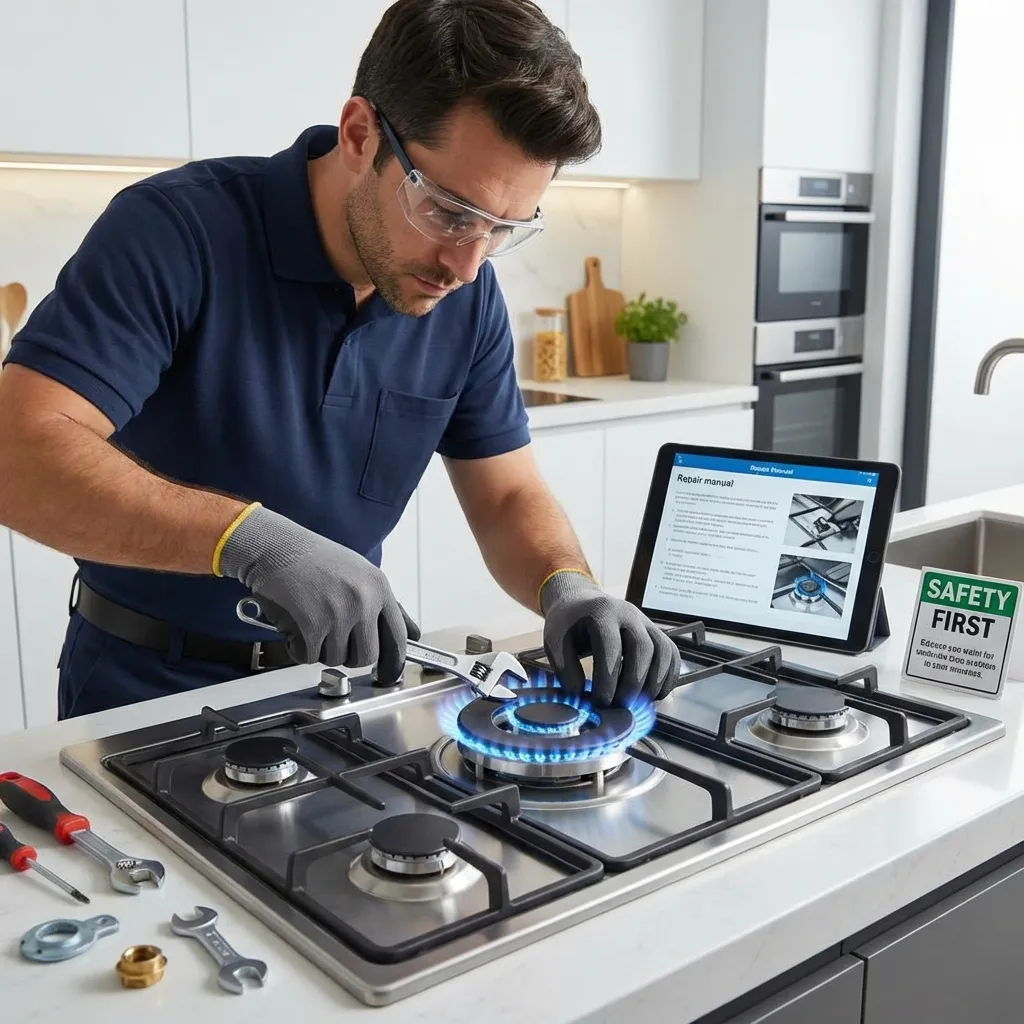
Gas burners have a ring of small ports (holes) through which gas flows. Cooking spills, grease, and food debris can block these ports, preventing gas from flowing evenly and causing the flame to be uneven, sputtering, or absent on one side.
Cleaning clogged ports is straightforward: remove the burner cap and grate, and use a straight pin or needle to clear each port. Do not use a wooden toothpick, as it can break off inside the port. After clearing the ports, wipe the burner head clean and reassemble.
2. Faulty Spark Igniter
Most gas stoves use spark igniters to light the burners. When you turn the knob, the igniter produces a rapid clicking sound and a spark that ignites the gas. If the igniter fails, you may hear no clicking at all, or the clicking may be rapid and erratic without producing a consistent spark.
To test, turn on a different burner. If it clicks and lights normally, the igniter module is working and the problem is isolated to one burner's igniter electrode. If none of the burners click, the spark module may have failed.
A faulty igniter electrode is usually caused by grease or moisture on the ceramic insulator. Clean the electrode with a dry cloth and try again. If cleaning does not resolve the issue, the electrode needs replacement.
3. Misaligned Burner Cap
On gas stoves, the burner cap must sit flush on the burner base for the flame to ignite and burn properly. If the cap is even slightly misaligned — which often happens after cleaning — gas may not flow to the igniter correctly, resulting in a burner that clicks but will not light.
Remove the burner cap, inspect the base for debris, and replace the cap so it sits level and fully seated. You should feel or hear it click into place.
4. Gas Valve Problem
Each burner has a gas valve controlled by the knob. If the valve fails internally, it may not open fully, resulting in a weak flame, or it may not open at all. Gas valve problems are less common than igniter or port issues but do occur, particularly on older stoves.
A gas valve that will not shut off is a safety hazard — if you turn the knob to off and the flame continues, turn off the gas supply and contact a technician immediately.
5. Weak Flame on All Burners
If all burners produce a weak or yellow flame, the problem is likely with the gas supply, not the individual burners. Check that the gas shut-off valve behind the stove is fully open. If the flame is yellow rather than blue, the air-gas mixture may be off — this requires adjustment by a licensed gas technician.
Step-by-Step: How to Fix an Electric Stove Burner
Step 1: Swap the Burner
Remove the coil from the non-working position and plug it into a working socket. If it heats in the new position, the coil is fine and the original socket or switch is the problem. If it does not heat in any position, the coil has failed and needs to be replaced.
Step 2: Inspect the Element Socket
If the burner works in one position but not another, look at the socket on the non-working position. Check for burn marks, loose connections, or pitted contacts. If the socket is damaged, replace it.
Step 3: Test the Infinite Switch
If the socket looks good but the burner still does not work in one position, the infinite switch may be faulty. Remove the knob and access the switch behind the control panel. Test the switch terminals with a multimeter while turning the knob from off to high. The switch should send voltage to the element terminals when in any on position. No voltage means a failed switch.
Step 4: Check Wiring
While you have the control panel open, inspect the wiring between the switch and the element socket. Look for burnt connectors, melted insulation, or loose wires. Repair or replace any damaged wiring.
Step-by-Step: How to Fix a Gas Stove Burner
Step 1: Clean the Burner Ports
Remove the burner cap and grate. Use a straight pin to clear each port around the burner ring. Wipe the burner head clean with a damp cloth and dry it thoroughly. Reassemble and test.
Step 2: Reseat the Burner Cap
Remove the burner cap and examine the base for debris or spills. Clean the base and the underside of the cap. Place the cap back on the base so that it sits level and clicks into position. An improperly seated cap is the most common cause of a gas burner that clicks but will not light.
Step 3: Clean the Igniter Electrode
Locate the small ceramic igniter near the burner — it is the white or grey nub that sparks when you turn the knob. Wipe it clean with a dry cloth. If it is wet, allow it to dry before testing. Grease and moisture on the electrode can prevent sparking.
Step 4: Test Other Burners
Turn on the other burners one at a time. If they all click and light, the spark module is working and the problem is isolated to one igniter electrode. If none of the burners produce a spark, the spark module or the power supply to it may have failed.
Step 5: Check the Gas Supply
If the burners spark but no flame appears, verify that the gas supply valve behind the stove is fully open. If it is open and there is still no gas, contact your gas utility provider.
When to Call a Professional
If you have worked through the troubleshooting steps and your burner still does not work, or if you discover a gas leak, a valve that will not shut off, or a cracked glass cooktop, call a professional immediately. Gas appliance repairs in particular should be performed by a licensed technician.
Appliance Service Plus services all major stove brands at homes across Toronto, Brampton, Vaughan, and the GTA. Their technicians carry common replacement parts and can usually complete a burner repair in a single visit.
Frequently Asked Questions
Why does my gas stove keep clicking but not lighting?
The most common cause is a misaligned burner cap or moisture on the igniter electrode. Remove the cap, clean the base and electrode, and reseat the cap so it sits flat. If clicking persists, the igniter electrode may need replacement.
Can I still use my stove if one burner is not working?
Yes, you can use the remaining burners while the faulty burner is being diagnosed or repaired. Just make sure the faulty burner is turned off at the knob and, for gas stoves, that no gas is leaking from the non-functioning burner.
How much does it cost to replace a stove burner in Toronto?
For electric coil stoves, a replacement coil element costs $15 to $50 and is easy to install yourself. Infinite switches cost $30 to $80 plus labour. For glass-top stoves, a radiant element replacement costs $100 to $250 including labour. Gas igniter electrodes cost $20 to $50 plus labour. Most professional repairs total $150 to $300 in the Toronto area.
Why is my stove burner only heating on high?
This usually indicates a failed infinite switch that has lost its ability to regulate power across the full range. The switch sends full voltage in all positions, so the burner only heats on high. Replace the infinite switch for that burner position.
How do I know if my glass cooktop is damaged?
Cracks, chips, or deep scratches in the glass surface are signs of damage. A cracked cooktop is an electrical hazard and should not be used until replaced. If the radiant element beneath the glass develops a hotspot (a section that glows much brighter than the rest), it may be failing and should be inspected by a technician.
Need Professional Help?
If the problem persists or seems too complex to handle on your own, our expert technicians are ready to help. Fast, reliable service when you need it.